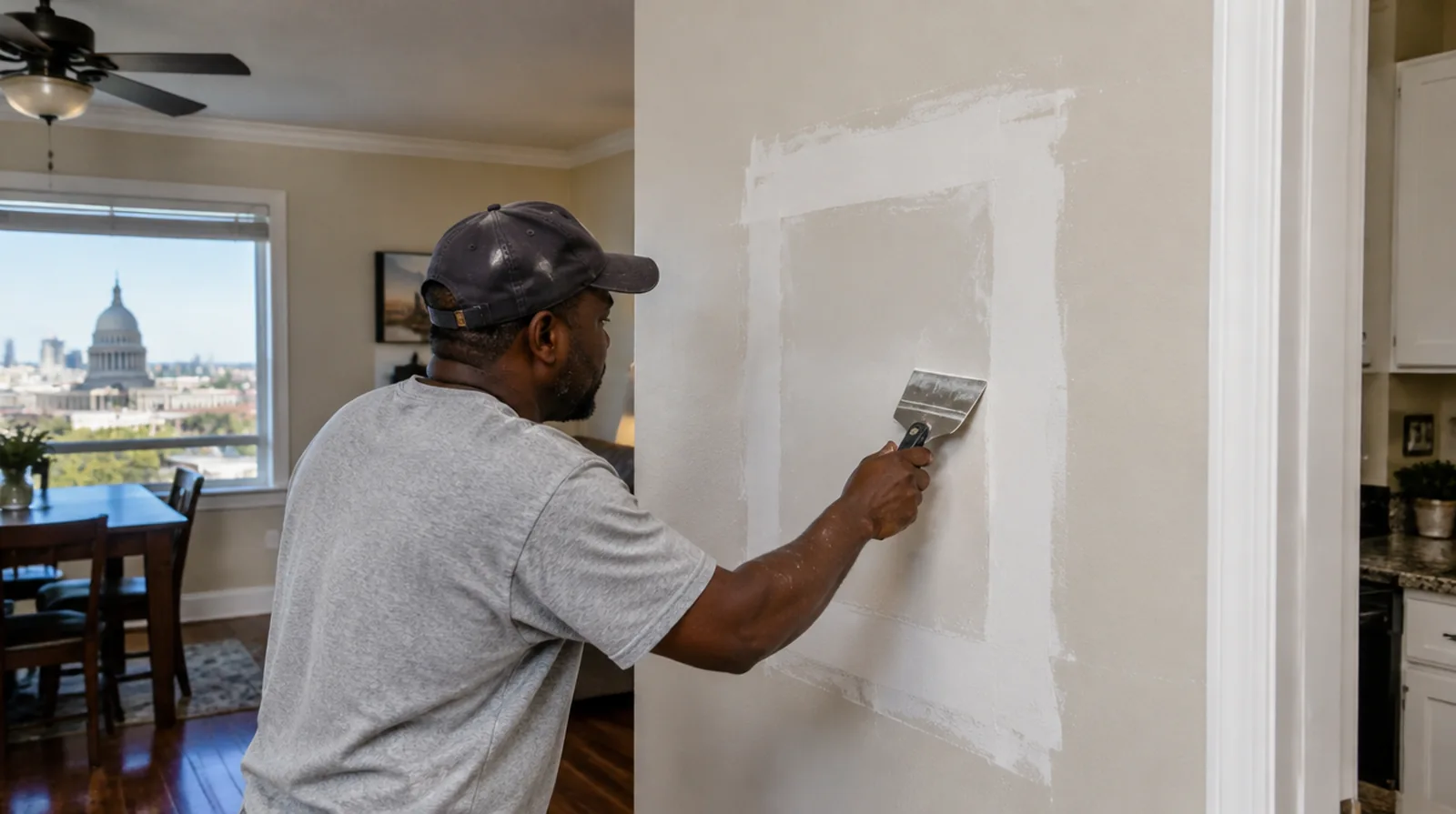
Choose the patch boundary
Loose paper and crumbling gypsum must be removed until the surrounding panel can support a durable repair. Squaring an opening may create a practical edge for backing and a securely fitted replacement. For a surface that will receive wall covering, share the product requirements early so the finishing stage supports the planned decorative treatment.
Set the paint boundary
Even a well blended patch can remain visible when touched up with an aged or unavailable paint color. Consider a corner to corner decorative boundary when color or sheen differences would otherwise remain noticeable. When the history of a repair is uncertain, note when it became noticeable and whether its appearance has altered across differing seasons.
Build thin finishing coats
Shaping a repair through thinner coats gives more control than depositing all the material at once. Each layer needs sufficient time needed for drying before the next pass can be judged accurately. At the handover inspection, review the finish from ordinary room positions using the lighting conditions that were agreed for the work.
Support the replacement
Larger openings need a fitted board patch secured to framing or suitable backing rather than a thick mound of compound. The replacement thickness of the board should match the original face so the joint can finish level. For an older repair with no clear history, describe when the mark first appeared and whether it has changed through more than one season.
Protect adjacent surfaces
Small wall repairs can still distribute fine dust through the room if protection is inadequate. The work plan should identify what needs moving and which room can remain in use. When a quote includes multiple visits, ask what happens during each stage and when the room needs to remain undisturbed between coats.
Feather beyond the opening
The noticeable finishing area usually extends farther than the hole because a gradual taper hides the repair edge. A broad blend reduces the ridge that otherwise appears when light travels across the wall surface. If the finish paint is already chosen, share its sheen and color early because those choices influence how substrate preparation is judged.
Identify the cause
Damage from an impact is not assessed in the same way as a seam that keeps splitting at a door opening. Describe any change in the defect and check whether the surrounding board is still stable. When damage followed other building work, describe the nearby alterations and the sequence between those changes and the first visible defect.
Review with side lighting
Use an angled view as well as a direct view when reviewing a finished patch. Checking from more than one angle helps separate surface imperfections from differences in decorative paint sheen. If the problem developed after another renovation, explain which nearby materials or building systems changed before the damage became visible.

Reinforce panel seams
Joint tape bridges the transition between the original wall and a replacement section. Embed the chosen tape fully in its intended compound so the edges bond without bubbles. If an independent painter completes decoration, agree the condition of the handed over surface and assign responsibility for small final corrections.
Document recurring movement
Cracks that return after cosmetic repairs deserve a conversation about movement or moisture rather than another quick cover. State any moisture or movement concerns that another professional must resolve ahead of the drywall repair. At a ceiling or wall containing fittings, assign removal and reinstatement duties for the affected devices before repair access is needed.
Project context in Jackson
Note whether the old edges are raised, whether the paint sheen changes across them and whether the underlying material remains firm. A Jackson room with visible outlines from older patches needs an assessment of more than the latest blemish.
Scope questions before finishing
If the problem developed after another renovation, explain which nearby materials or building systems changed before the damage became visible.
For an initial assessment from pictures, provide an overall room photograph and a detailed view of the defect so both context and scale are apparent.
If the coating stability is unclear, assess which layers are adequately bonded and which should be removed rather than simply hidden beneath new material.
For a distinctive existing pattern, retain a reference sample or detailed picture to make the matching discussion more specific.
When comparing competing estimates, make sure their protection, surface finish and disposal allowances describe equivalent work before comparing the final prices.
While a removed panel exposes the wall cavity, complete the necessary review of concealed work before replacement board closes the opening.
When a wall has repeated defects, keep a record of earlier repair attempts so a new assessment does not simply repeat an unsuccessful approach.
For walls beside bright windows, review a dry sample from an oblique angle as well as looking straight at the repaired surface.
Where the wall meets fixed furniture, clarify whether removal is included or whether the finish will terminate at the accessible edge.
For an older repair with no clear history, describe when the mark first appeared and whether it has changed through more than one season.
In a room with little free floor space, identify temporary storage for belongings and establish sufficient clearance for the work before delivery.
For a surface carrying numerous paint layers, discuss whether differences in the retained profile or sheen justify decorating a broader area.
Explore the Jackson drywall overview for related options, or read the project planning information before arranging the next stage.
More planning details for Jackson
A broad skim treatment may address surface variation, but it is not a substitute for investigating active moisture or movement. Share any history of seasonal changes so the proposal can separate those concerns. In humid weather, allow the room to reach suitable working conditions before setting a tight finishing deadline.